Kinetronics Locomotion Checkpoint
This page is intended to be included by index.php. It contains no HTML, HEAD, or BODY tags so the site's master template controls the appearance.
Engineering Statement. In e-bike cycling, the rider produces locomotion through biomechanical power supplemented by electronically managed, electrically powered mechanical torque transmitted through the bicycle drivetrain.
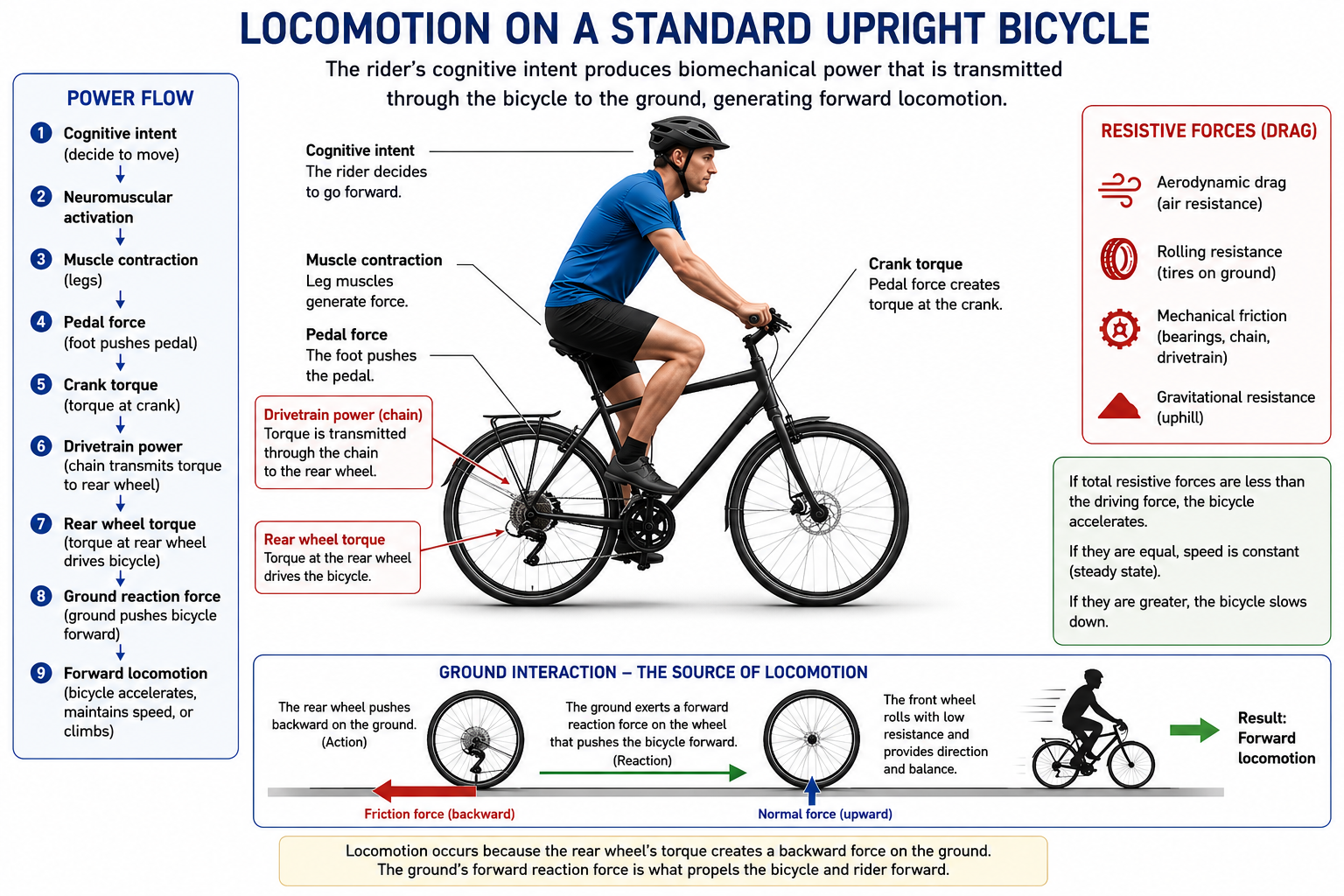
1. Locomotion
Locomotion is the controlled movement of a rider-bicycle system through interaction with the ground.
2. Human Cognition
Human cognition initiates locomotion. Cognition precedes neuromuscular activation and biomechanical power generation.
3. Biomechanical Power
The rider generates biomechanical power through muscular contraction. Pedal force creates crank torque that is transmitted through the drivetrain.
4. Mechanical Joints
Mechanical joints transmit, regulate, or isolate energy. During coasting, the freehub functions as an energy-disjoint joint.
5. Drive and Drag
Drive and drag are the two functional force categories governing bicycle locomotion. Net locomotion depends on their balance.
6. Power Meter
Conventionally a bicycle power meter reports transmitted mechanical power. Within the Kinetronics framework it is interpreted as measuring transmitted mechanical load resulting from drag and inertial loading.
7. Coasting
Coasting is passive locomotion. No rider drive power is transmitted while stored kinetic energy is dissipated by drag forces.
8. E‑Bike Locomotion
The rider remains the producer and controller of locomotion. Electrical assistance supplements rider-generated biomechanical power through electronically managed motor torque.
9. Energy Flow
Human cognition → Neuromuscular activation → Pedal force → Crank torque → Drivetrain → Rear wheel → Ground reaction force → Locomotion.
10. Summary
This checkpoint establishes the current Kinetronics framework integrating cognition, biomechanics, mechanical joints, drive, drag, coasting, power measurement, and electrically assisted cycling.